Host-driven apps
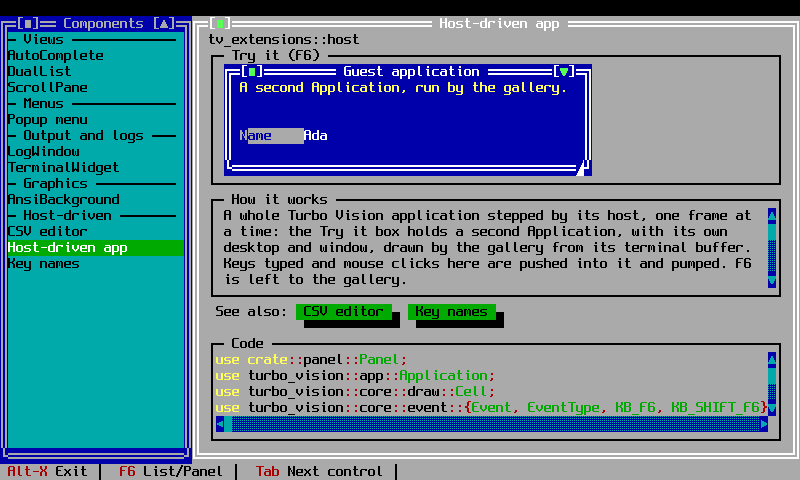
Turbo Vision was written for a program that owns its terminal. Application::run sits in a loop, asks the backend for the next event, waits up to a few milliseconds for one, and draws whenever something changed. That shape does not fit an embedder. A plank frame, a WASM guest or a test harness has its own loop and its own screen, and it calls into the application when it has something to hand over: a key, a resize, or just the next frame. The host module turns turbo-vision inside out so it can be driven that way.
The pieces
HostBackend is a Backend with no terminal behind it. Its input is a queue, its size is whatever the host last said, and its output goes nowhere, because the host reads the finished cells straight out of Terminal::buffer. HostInput is the host's end of that queue. It is cheap to clone, so it can live wherever the host receives its input, and it offers push for an event and set_size for a new screen size. host::app(w, h) builds the three together and returns the application with its input handle.
pump(&mut app, &mut handler) is one frame. It first checks whether the host changed the size, and if so it runs the same re-layout a terminal resize gets. Then it takes every queued event in order and gives each one to Application::step, which draws any pending redraw and then does one pass of the event loop, the pass run does for each event it reads. When the queue is empty it steps once more with no event, which is where idle work and AppHandler::idle run, and finally it draws. It returns whether the application is still running, and turns false once something quits it with CM_QUIT or Alt+X.
Nothing in this path waits. HostBackend::poll_event returns the next queued event or nothing, immediately, so a frame costs only the work the events cause.
Why modal calls are refused
Much of Turbo Vision's API is modal. exec_view, execute_modal, a message box, the history list under an input line and a dropdown's list all run a nested event loop and return only once the user closes them. Under a host that is a trap: the nested loop would poll a queue nobody can fill while the application holds the host's thread, so the frame would never return.
A HostBackend answers true to Backend::is_host_driven, and turbo-vision reads that once, when the application is built. From then on those calls return CM_CANCEL straight away instead of looping, and the history and dropdown popups simply do not open. The tests pin this down by pushing CM_SHOW_HISTORY and CM_SHOW_DROPDOWN and checking that a pump comes back promptly.
The consequence for an application is that dialogs have to be modeless. Add the dialog to the desktop, keep a note of what it is for, and act on its commands in the handler as they arrive. plank's csvedit guest keeps an overlay field for exactly this: its open, save and confirm dialogs are ordinary desktop children, and the handler closes them and applies the answer when their buttons send a command.
The plank frame example
A plank frame component receives a key at a time and is asked to paint at a given size. csvedit wraps its application in a small session that maps each of those onto a pump:
use tv_extensions::host::{self, HostInput};
use turbo_vision::app::Application;
use turbo_vision::core::event::Event;

pub struct Session {
    app: Application,
    input: HostInput,
    state: State, // the AppHandler: document, handles, open overlay
}

impl Session {
    pub fn key(&mut self, ev: Event) -> bool {
        self.input.push(ev);
        host::pump(&mut self.app, &mut self.state)
    }

    pub fn step(&mut self, w: u16, h: u16) {
        self.input.set_size(w, h);
        host::pump(&mut self.app, &mut self.state);
    }

    pub fn cells(&self) -> &[Vec<turbo_vision::core::draw::Cell>] {
        self.app.terminal.buffer()
    }
}
Keys go in through the queue and come out as a redrawn buffer in the same call, and a resize is just a new size followed by a pump. When key returns false the application has quit and the frame can close.
One detail of layout is worth knowing. Without a menu bar and a status line, turbo-vision's desktop keeps a spare row at the top and bottom, as Borland's does. An embedder that wants the whole screen for its windows either sets a menu bar and status line, as csvedit does, or sets the desktop's bounds to the full screen.
The cursor
A host-driven application has no terminal cursor of its own to fall back on, so HostInput::cursor() reports where the application last put one: the screen cell (x, y) a focused control showed its text cursor at after the last pump, or None while nothing shows one. A host that can place a real cursor moves it there each frame; one that can't can instead redraw that cell in reverse video.